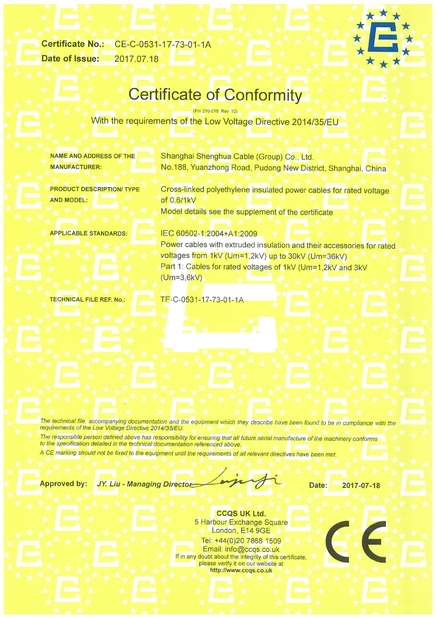
Cable de Shangai Shenghua (grupo) Co., Ltd.
Drum length looks like a detail and behaves like a price. A 1000 metre drum is cheaper per metre than a 500 metre drum of the same cable, a coil is cheaper again for small sizes but unsuitable for long pulls, and a short drum that is labelled long is one of the most common and least discussed forms of short delivery. Length is also where installation waste comes from: a route that needs 840 metres and arrives as a 500 metre drum leaves a joint that nobody planned. This guide explains how cable length is measured and packed, how drum size affects cost and handling, how to specify lengths for a project and how to verify what you received. Six answers follow on tolerance, weighing, joints and packing.

Cable length is measured during production, usually by a wheel or a laser counter that the extrusion line uses to record the delivered length. The counter drives the metre marking on the sheath, which is why the print and the drum label should agree. A discrepancy between them is a warning sign.
Packing follows size and volume. Small cables, typically up to 16 or 25 square millimetres, are supplied on coils of 100 metres for handling by hand. Medium sizes go on wooden drums of 500 or 1000 metres, and large sizes on steel or heavy wooden drums with shorter lengths because of weight. The drum itself is a cost item, and it may be returnable, disposable or chargeable depending on the market.
Standards permit a length tolerance, and the tolerance is negative as well as positive. A drum sold as 1000 metres may legally contain slightly less, within the permitted tolerance, and the buyer who does not check is paying for metres that were never delivered. The tolerance is small in percentage terms and significant across a large order.
Weight provides an independent check. If the conductor size, the number of cores and the construction are known, the theoretical mass per metre can be calculated, and the drum gross weight minus the drum tare should correspond. A drum that is consistently ten percent light for its stated length is either short or built with less copper.
The first reason is direct cost. Cable is bought by the metre, and a short delivery is a price increase disguised as a delivery. On a large project, a two percent shortfall across thousands of metres is a substantial sum, and it is rarely noticed because nobody weighs the drums.
The second reason is installation planning. A long pull that runs out thirty metres short requires a joint in a location that may be inaccessible, and a joint is both a cost and a reliability risk. Specifying lengths that match the route, with a sensible allowance, prevents this.
The third reason is handling cost. A 1000 metre drum of a large cable may weigh several tonnes and require a crane; a 500 metre drum may be handled with a forklift. The choice affects the site equipment needed and the time to install, and it should be decided with the installer, not by the factory's convenience.
The fourth reason is waste. Offcuts from a coil are often discarded, while offcuts from a drum can be used elsewhere. Matching packing to the actual cutting plan reduces waste, and on a large project that reduction is measurable.
The fifth reason is corrosion and damage. Cable stored on a drum in the open for months can be damaged at the outer layer, and a partially used coil left on site deteriorates faster than a sealed drum. Planning delivery in the right lengths and quantities avoids long site storage.
State the length per drum and the total quantity in metres, not in drums. A purchase order that says ten drums is ambiguous; one that says 10,000 metres in 1000 metre drums is not. Where a specific length is needed for a pull, state it as a separate item.
State the packing type: wooden drum, steel drum, coil, returnable or disposable. State whether drum return is expected and who pays the freight. These details are usually negotiable and always cheaper to agree before production than after.
Verify on receipt. Compare the metre marking at both ends with the drum label, and check the counter reading if the factory provides one. Where the marking is continuous, the difference between the first and last reading is the delivered length.
Weigh the drum for larger orders. Gross weight minus tare, compared with the theoretical mass for the size and construction, gives an independent estimate of length and copper content at the same time. This single check catches both short length and undersized conductor, and it takes a few minutes with a platform scale.
Record the results per drum in a receiving log. Over a few deliveries, the log shows whether a supplier is consistently accurate, consistently short or variable, and it turns a vague suspicion into a documented fact. Products such as the UV Resistant Aerial 0.6/1kV 3x185mm2 Aluminium XLPE Insulated Power Cable Overhead Coastal Line and the Shanghai Shenghua Power Cable Professional Control Flexible Wire Cable Eco Friendly CE KEMA Certification are typical of items where the drum length decision has a real effect on installation cost.
A drum is a handling device as well as a container, and its size must match the equipment on site. A drum that is too large for the available crane or forklift becomes a problem at the delivery point, and moving it later is expensive. Confirming the lifting method before ordering, and stating the maximum drum weight the site can handle, avoids this entirely.
Storage matters for the cable as well as the drum. Drums should be stored upright on firm ground, with the cable ends sealed, and away from standing water. A drum stored on its side for months can deform the cable under its own weight, and the deformation may not be visible until the cable is unwound.
For coils, storage is easier in one sense and harder in another: a coil can be moved by hand, but it is more exposed to damage and to ultraviolet light. Coils stored outdoors should be covered, and the outer wraps should be inspected before use.
A cutting plan that matches the drum lengths to the actual route reduces both waste and joints. The plan should account for the vertical risers, the terminations and a sensible allowance for pulling and trimming. An allowance that is too small creates a shortfall at the worst moment; one that is too large creates offcuts that are often discarded.
Where a route requires more than one drum length, the joint location should be planned rather than accepted. A joint in an accessible position with a proper enclosure is a normal part of an installation; a joint in a duct or under a floor is a future problem. The cable order can usually be arranged to place joints where they can be maintained.
Finally, record the actual lengths used. Over several projects, the records show how accurate the estimating is and where the waste occurs, and that information is what improves the next cutting plan. The exercise costs little and returns a measurable saving on every subsequent order.
Cable is dense, and container capacity is usually limited by weight rather than by volume. A 20 foot container takes roughly twenty tonnes, which for a large power cable may be only a few drums. Planning the drum sizes and the quantities together allows the container to be filled efficiently, and that planning can reduce freight cost per metre measurably.
Drum dimensions also matter. A drum that is slightly too large for the container door cannot be loaded without special handling, and the discovery is made at the port. Stating the maximum drum diameter and weight with the order avoids the problem entirely, and it costs nothing at the quotation stage.
For mixed orders, packing the drums and the coils together in a sensible sequence reduces handling at both ends. A packing list that states drum number, length, size and gross weight makes the receiving process straightforward and allows the buyer to verify the delivery against the order without unwinding anything.
Confirm the total metres, the length per drum, the drum type, the maximum weight the site can handle and whether drums are returnable. Each of those affects the price per metre and the handling at both ends.
Weighing the drum on arrival, and comparing with the theoretical mass, checks length and conductor content in a single operation that takes a few minutes.
The installer knows the route, the access and the equipment available, and their input at the ordering stage prevents most handling problems. A short conversation about drum weights, lifting points and the sequence of pulls is more useful than a specification clause, and it costs nothing.
Where the site has limited storage, delivering in stages matched to the installation programme reduces the risk of damage and theft. A cable that sits on site for months is exposed to weather, to construction traffic and to accidental damage, and the cost of that exposure is rarely accounted for when the order is placed.
Standards permit a tolerance, which can be negative. Check the marking and, for large orders, weigh the drum.
Coils of 100 metres for small sizes, drums of 500 or 1000 metres for medium sizes, and shorter lengths for large heavy cable.
It depends on the market and the agreement. State the requirement in the order; returnable drums usually carry a deposit.
Read the metre marking at the start and end, and compare the gross weight with the theoretical mass for the size and length.
For small sizes, yes, because there is no drum cost. Coils are unsuitable for long pulls and for large sizes.
Document the measurement, photograph the marking and raise it with the supplier. A receiving log makes the claim straightforward.
Length is a commercial term disguised as a technical one, and it is verified by reading the marking and weighing the drum rather than by trusting the label. Specify metres rather than drums, state the packing and return arrangements, and keep a receiving log. Shanghai Shenghua Cable Group supplies PVC insulated cable in coils and on wooden or steel drums with continuous metre marking, and it states the delivered length and drum type on every packing list. Send your cutting plan through our contact page and we will propose drum lengths that match your installation. Related items include the Temperature Rating -20C To 70C Multi Core Sheathed Steel Wire Armored PVC Insulated Cables For Underground Ins, the NYY 4x25mm2 Oxygen-Free Copper PVC Insulated Low Voltage Power Cable 0.6/1kV Underground, the Three Phase core copper conductor unarmored 600/1000V 3x10mm2 XLPE Insulated Power Cable, the 90℃ 2 - 5 Cores XLPE Insulated Power Cable With PVC Jacket, the Waterproof Moisture Resistant PVC Insulated Cable 0.6/1kV 2 Core 2x4mm2 Outdoor Wet Area Use and the XLPE Insulated Power Cable For Industrial PVC/LSZH Jacket High Temperature Resistance.
An installer involved at the ordering stage prevents the handling problems that no specification clause can resolve.
Matching delivery to the programme protects the cable and reduces site congestion.
Length, packing and handling are commercial terms with technical consequences, and they deserve the same attention as the cable itself.
A receiving log converts them from assumptions into facts.
Over several orders, that record is what makes each delivery verifiable in minutes.